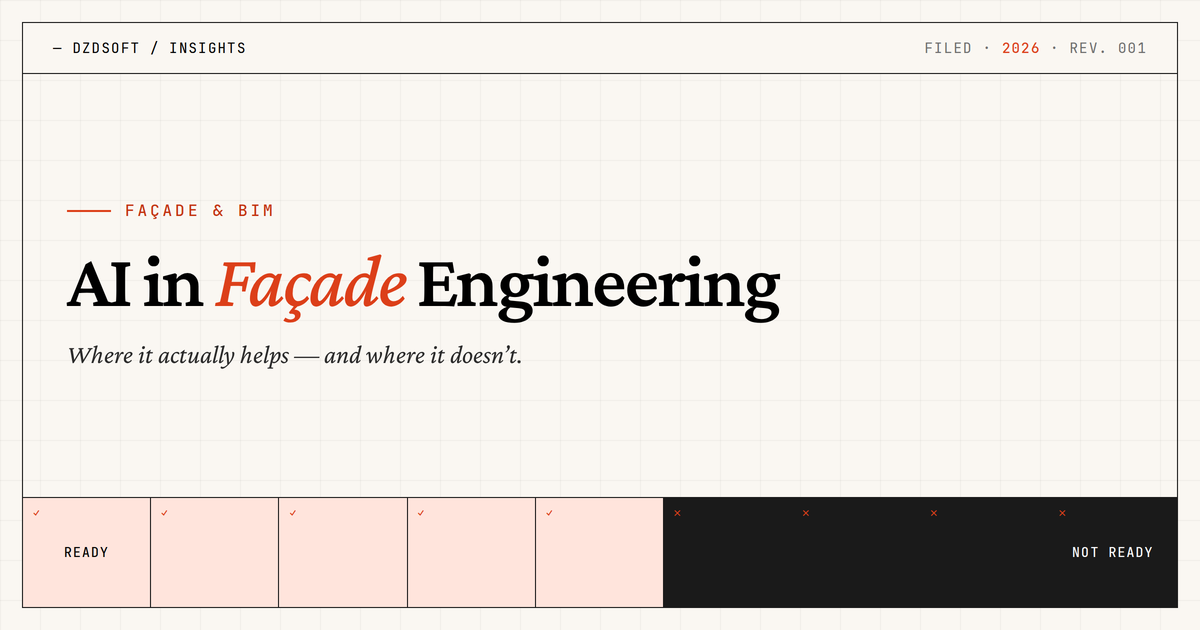
AI in Façade Engineering: Where It Actually Helps — and Where It Doesn’t
Artificial intelligence is now real inside façade engineering workflows — helpful for concept optimisation, energy prediction and BIM coordination, but still unreliable for structural sizing, fabrication tolerances and code compliance. Knowing which is which is the whole game.
The hype has finally met a hard discipline
Façade engineering is one of the least forgiving corners of the construction industry. A curtain wall has to survive wind loads, thermal movement, seismic drift, water infiltration and a 25-year service life — while looking like the render. That is exactly the kind of discipline where careless AI hurts and careful AI helps a great deal. In 2026 the honest question is no longer “will AI change façade engineering?” It is “which parts have actually changed, and which parts should you still not hand to a model?”
DZDSoft has spent years inside this specific intersection — façade calculation software, BIM object libraries, industry data platforms — so this piece is written from the workflow, not the marketing deck. Here is the useful map: five places AI is already earning its keep, four places it is still a liability, and how to build a stack that uses it without losing engineering rigour.
| Task | AI in 2026 | Practical rule |
|---|---|---|
| Envelope optimisation | Ready — multi-objective, seconds not weeks | Use for concept & competition phases |
| Energy & daylight prediction | Ready as ML surrogate on validated data | Great for orientation & sensitivity checks |
| BIM clash detection | Ready — predicts before models complete | Layer on top of manual coordination |
| Tender & spec review | Ready with LLM first-pass | Human validates exceptions |
| Structural sizing | Not ready — deterministic only | Keep in Robot, SAP, CalculiX etc. |
| Shop drawings | Not ready — tolerances still human | AI drafts, humans detail |
| Code compliance | Not ready — jurisdiction hallucination | Never delegate to LLM |
| Client BIM & drawings | Only under NDA-safe hosting | Answer residency before upload |
Where AI actually helps today
1. Early-stage envelope optimisation. Generative and multi-objective algorithms now explore thousands of façade permutations in seconds — window-to-wall ratio, shading depth, glazing selection, orientation — against energy, daylight, glare and cost targets simultaneously. Recent BIM-based generative studies report roughly 6.7% reduction in heating loads and 3.5% reduction in cooling loads against reference envelopes, in optimisation runs measured in seconds rather than weeks. For competition and concept phases this is genuine leverage.
2. Energy and thermal-resilience prediction. Machine-learning surrogates trained on validated EnergyPlus datasets can now predict envelope performance and thermal resilience during power outages in real time. In one 2026 study spanning 14 ASHRAE climate zones and nearly 17,000 scenarios, feature-importance analysis showed windows drive roughly 74% of the envelope-related passive thermal response — a result that would take days of simulation to reach conventionally and now returns in seconds. Useful for orientation trade-offs and quick sensitivity checks.
3. BIM coordination and clash detection. Autodesk’s Revit generative features, Bentley’s AI-assisted civil tools, and third-party platforms like Finch and TestFit have moved from experiments to production. Machine-learning clash detection can predict likely collisions from patterns in previous projects before the model is even complete — especially valuable at the messy interface between façade brackets, MEP risers and structural embedments.
4. LLM-assisted specifications and takeoffs. Large language models are surprisingly effective at parsing tender documents, extracting façade scope, matching it against product libraries and flagging inconsistencies. A tender-review task that used to take a senior engineer a full day now runs in an hour with a competent LLM handling the first pass and a human validating the exceptions.
5. Visualisation and communication. Graphisoft’s AI Visualizer and comparable tools convert massing models to detailed façade visuals in minutes. Not final renders, but decisive during client reviews when you need to test a materials palette against three variants before lunch.
Where AI is still a liability
1. Structural sizing and safety-critical calculations. Mullion and transom sizing, anchor design, seismic response and dead-load transfer are governed by Eurocode, ASCE, TS EN and local amendments. LLMs will happily confabulate numerical answers that look plausible and are wrong. These calculations belong in deterministic engineering software with traceable assumptions — not a probabilistic model. The industry is not remotely ready to certify AI-generated structural sizing, and neither are we.
2. Fabrication tolerances and shop-drawing detail. A four-side-structural-glazing joint needs to be right to the millimetre. Vision models still hallucinate joint geometry, misread section profiles and generate details that would fail on the first mock-up. Human detailing remains the standard here for good reason.
3. Code compliance and jurisdictional interpretation. Regulations vary by country, city and even project type. An LLM trained on generalised web data will confidently cite outdated standards or the wrong jurisdiction — and that error surfaces in permit review, not in a git diff. Compliance is one place where reliability, not creativity, is the entire point.
4. Client and project data privacy. Uploading a client’s BIM model, tender documents or shop drawings to a public LLM is a data-governance problem. Under KVKK, GDPR and most client NDAs, that content should not leave a controlled boundary. Any AI in a façade practice has to be architected with retention, training and residency clearly answered up front.
The stack we recommend to façade practices
The pattern that works is not “buy one AI tool” but a small, layered stack you actually control. At the concept end, a generative/optimisation tool inside Rhino-Grasshopper or Revit-Forma explores envelope options against energy and cost objectives. At the coordination end, an ML-augmented clash detection layer flags coordination risk earlier than manual review. On the document side, a privately hosted or contractually restricted LLM handles tender parsing, specification review and multilingual project correspondence — while structural calculations, fabrication detailing and compliance sign-offs stay in traditional deterministic software with a human engineer’s name on them.
The two rules that keep this honest: every AI output feeds a human check before it leaves the office, and every integration is API-first and modular so tools can be swapped as the field moves — and it will move.
What we build at DZDSoft
DZDSoft’s in-house platforms — FacadCAL+, BIMfacad, Cepheye Dair, DataCenter Hub — sit exactly at this intersection: deterministic engineering where correctness matters, ML augmentation where it earns its keep, and clean APIs everywhere so nothing is locked to a single vendor. If you need a façade practice retooled for 2026 without the theatre — concept optimisation wired into your BIM library, an LLM layer that respects your NDAs, and clear rules about what AI never touches — that is exactly the integration work we do.
- Pick one high-value slot to pilot first — concept optimisation or tender review are the safest wins.
- Keep structural calculations, shop drawings and code compliance in deterministic tools with named engineers.
- Answer data retention, training and residency before any client model or drawing touches an LLM.
- Build every AI integration API-first so you can swap models as the field evolves.
- Make every AI output a draft — not a deliverable — until a human engineer signs it off.
- Track the actual time and quality delta after 90 days; kill anything that doesn’t clear the bar.
- In 2026 AI genuinely accelerates concept optimisation, energy prediction, BIM coordination, specification review and visualisation.
- It is still unfit for structural sizing, fabrication detailing, code compliance and any workflow requiring deterministic accuracy or data confidentiality.
- The winning stack is small, layered, API-first and human-supervised — not a single “AI product” bolted on top.